

Yoga has been practiced for centuries to build strength, flexibility and balance while fostering a strong connection between the mind, body and spirit.
Today, growing research shows that yoga may also offer meaningful benefits for those on a cancer journey: lowering blood pressure and stress levels, as well as improve a person’s coping skills.
“One of the best exercises for cancer rehabilitation is yoga,” says Dr. Eric Turner, a board-certified, fellowship-trained medical oncologist with Beaufort Memorial Oncology Specialists. “Studies show the effect of yoga on cancer patients can be significant, and when used alongside medical treatments, yoga can help decrease some symptoms of cancer and cancer treatment, while also helping patients deal with what can be a very stressful diagnosis.”
Read More: Exercise Offers Help to Cancer Patients
How Yoga Helps People With Cancer
While yoga does not treat or cure cancer, it can play an important role in managing many of the physical and emotional side effects associated with cancer and its treatment.
Like other forms of gentle exercise, yoga may help patients cope with:
- Fatigue
- Sleep disturbances
- Anxiety
- Depression
- Reduced mobility or stiffness
Research indicates that yoga may help patients:
- Reduce pain
- Improve flexibility and overall mobility
- Enhance quality of life
- Support healthy stress hormone regulation and immune function
- Reduce inflammation
The American Cancer Society reports that one study showed that breast cancer patients who participated in hour-long yoga classes three times per week during six weeks of radiation therapy experienced less fatigue and an improved ability to perform daily activities.
“I often recommend yoga as a complementary practice during treatment,” Dr. Turner says. “Exercise in any form is helpful for people with cancer, and yoga is a good form to start with. It offers gentle poses you can do at home when you’re feeling up to it.”
Read More: Women’s Health Screenings by Age
Different Styles of Yoga
Interested in trying yoga? There are many different styles, and some forms are more intense than others. It helps to understand the terminology before you sign up for a class. Here’s a quick guide:
Ashtanga
The word ashtanga means “eight limbs” in Sanskrit. Ashtanga yoga, sometimes referred to as power yoga, is very physically demanding and requires moving rapidly between poses. These classes can be more difficult than others, so if you’re feeling unwell after treatment, this style may not be best for you.
Bikram
In a Bikram yoga class, you will practice in a room hotter than 100 degrees. You may also see this class called hot yoga. Some studies claim Bikram yoga can improve strength, range of motion and balance. Like Ashtanga, Bikram yoga can be strenuous and may be too difficult if you’re experiencing side effects from your cancer treatment.
Hatha
The term hatha is a generic term for yoga that involves poses and breathing techniques. This is a general style of yoga that is typically slow-paced.
Yin, or Restorative
In a restorative yoga class, the focus is on calming the body and relaxing the mind. This style is very gentle and allows you to spend a lot of time in poses. You may use props in this class, such as bolsters and blocks, to help support you as you settle into poses. Studies show restorative yoga may decrease fatigue and improve emotional well-being in cancer patients.
Read More: Do’s & Don’ts of Cardio
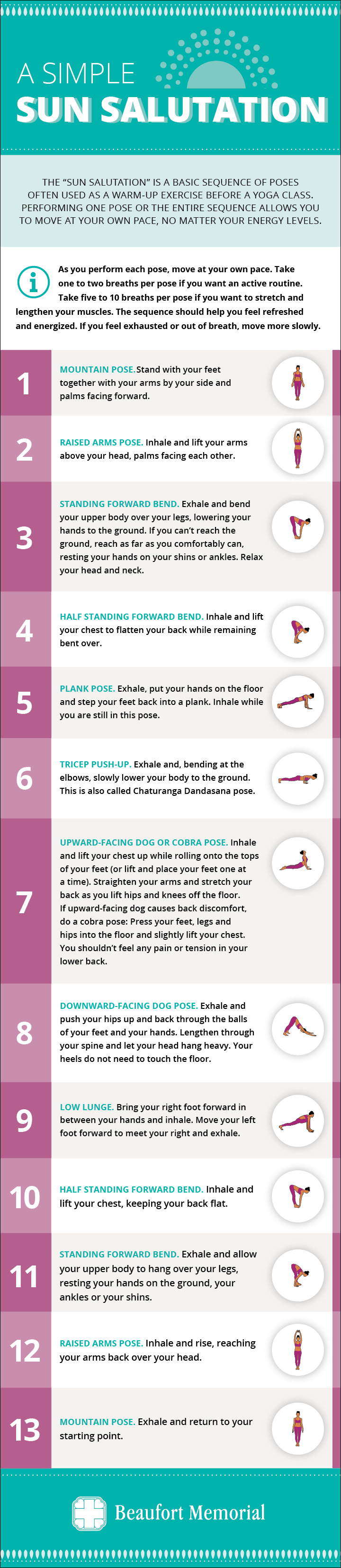
Get Started With a Simple Sun Salutation
During cancer treatment, you may not have the energy for a full yoga class. However, you may feel up for practicing a few simple poses at home. Try one or more of the poses below, and do as many as you feel up to.
The Beaufort Memorial LifeFit Wellness Center offers a free three-month membership to patients receiving cancer treatment at Beaufort Memorial. The free service requires a referral from your provider. Call 843-522-5635 to learn more.
Featured Medical Expert

J. Eric Turner, M.D.
Medical Oncology +1 more
Accepting new patients
Related Providers

J. Eric Turner, M.D.
Medical Oncology +1 more
Accepting new patients
Beaufort Memorial Oncology Specialists
989 Ribaut Road
Suite 310, Beaufort Medical Plaza (Use front entrance)
•
Beaufort,
SC
29902