
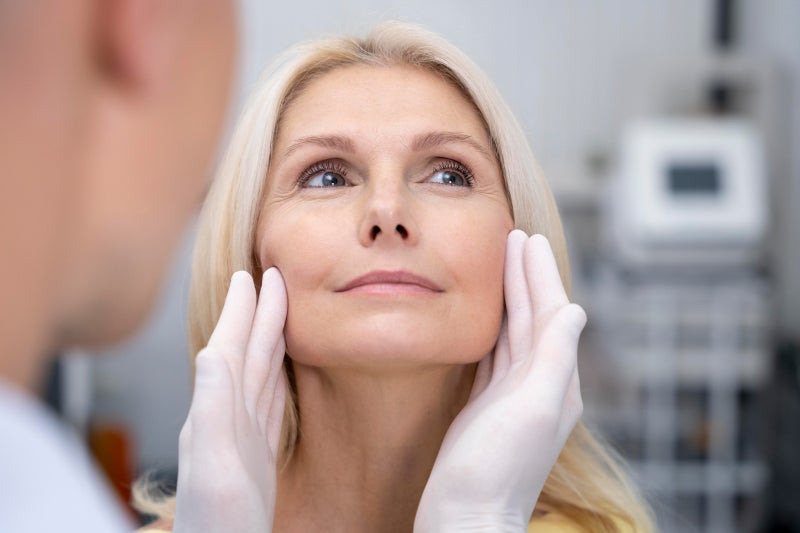
Looking for a new way to rejuvenate your face? You don’t have to head to the operating room.
Today, there are a growing number of options to renew your confidence and your facial skin, and one of the most exciting is called a liquid facelift.
“For the right person, liquid facelifts work very well to bring about the desired result,” says Dr. Heidi Harrington, a board-certified, fellowship-trained plastic surgeon with Beaufort Memorial Plastic Surgery & Aesthetics. “Instead of relying on a single injectable, the plastic surgeon picks and chooses between a number of options to provide a customized treatment plan.”
Read More: 6 Facelift Myths: Which Ones Do You Believe Are True?
What Is a Liquid Facelift?
A liquid facelift is a minimally invasive cosmetic procedure that takes place in your plastic surgeon’s office. Your surgeon uses a thin needle to inject special materials into your face to address minor volume loss and wrinkles that are common with aging.
Areas that can be treated with this approach include:
- Around the eyes, nose and mouth
- Cheeks
- Forehead
- Lips
- Temples
Most liquid facelifts take approximately one hour to complete, and the procedure is relatively painless. Your surgeon may use a local anesthetic to numb the target area or a cooling device to ensure your comfort throughout the procedure. You should be cleared to return to normal, daily activities soon. Common side effects, including redness or swelling, are mild. If experienced, these normally go away after a couple of days.
What Injectables Are Used in Liquid Facelifts?
“Every injectable has its niche, and all help add volume or reduce wrinkles,” Dr. Harrington says. “While we often use these tools separately, liquid facelifts let us use multiple injectables at once for a more comprehensive rejuvenation.”
Types of injected dermal fillers and other materials used in liquid facelifts include:
- Collagen-boosting fillers — The protein collagen helps skin remain plump and healthy. Human or animal collagen injectables replace the collagen that decreases with age, renewing deflated lips and other facial areas. Poly-l-lactic acid fillers are a type of collagen-boosting filler that aids in new collagen growth.
- Hyaluronic acid-based fillers — Hydrated skin is healthy skin. Produced by your body, hyaluronic acid helps hydrate the skin. Used properly, this acid can reduce visible wrinkles, facial folds and more. According to the American Society for Dermatologic Surgery, the results are immediate.
- Wrinkle reducers — Many use cosmetic Botox injections and other wrinkle reducers to reduce forehead wrinkles, crow’s feet and other minor facial wrinkles. These work by weakening muscles or blocking nerves that cause wrinkles. Once the muscles relax, the skin smooths.
Read More: Botox 101: Your Guide to Smoother Skin and More
Liquid Facelifts Vs. Surgery
Before committing to a liquid facelift over a surgical approach, it’s worth considering the differences. Here are three of the most important.
- Longevity — The average surgical facelift lasts a decade, according to the American Society of Plastic Surgeons. Though a liquid procedure provides quick results, these results don’t last as long as surgery. Some liquid procedures provide positive results for up to a year or longer.
- Procedure — A surgical facelift takes place in an operating room and involves incisions that must heal afterward. Go the liquid route, and your procedure takes place in your plastic surgeon’s office without a single incision.
- Recovery — There is practically no recovery to a liquid facelift. Undergo surgery, and you may notice minor swelling or bruising for up to a full year after surgery.
Is a Liquid Facelift Right for You?
Two criteria that make you a good candidate for a liquid facelift include:
- Experiencing minimal loss of volume in your face
- Having fine lines and wrinkles that you would like to address
“Choosing a cosmetic procedure is a deeply personal decision,” Dr. Harrington says. “If you like what a liquid facelift offers, it can be a great choice if you’re a good candidate.”
These procedures can be performed at any age. Whenever you notice either of these and want to correct it, talk with your plastic surgeon about your options.
Your surgeon may recommend a different option if you have excessive facial sagging or jowls. For either of these, surgery is a better option. You may also need a different skincare option if your medical history includes bleeding disorders or allergies to any of the materials used in injectables.
Read More: Liposuction for Men? It’s More Common Than You Think
Solid Facts on Liquid Facelifts
Correcting minor wrinkles and volume loss doesn’t always require surgery. Liquid facelifts offer a minimally invasive way to restore your skin’s youthful appearance in just one hour.
- During a liquid facelift, a plastic surgeon injects various materials into targeted areas to reduce wrinkles and enhance facial volume, creating a younger appearance.
- Based on your needs, your surgeon may recommend several injectables to help address the natural effects of aging.
- Choosing between a liquid and a surgical facelift is a personal matter. Consider the pros and cons of each and work with your plastic surgeon to move toward the solution that meets your needs.
Call 843-707-8020 or request a plastic surgery consultation online.
Featured Medical Expert

Heidi Harrington, M.D.
Plastic and Reconstructive Surgery
Accepting new patients
Related Providers

Heidi Harrington, M.D.
Plastic and Reconstructive Surgery
Accepting new patients
Beaufort Memorial Plastic Surgery & Aesthetics
122 Okatie Center Blvd. North
Suite 220, Okatie Medical Pavilion
•
Okatie,
SC
29909